 OpenStreetMap

Thanks for nothing.
Diary Entries in English
Recent diary entries
Posted by b-unicycling on 2 April 2026 in English.

As reported on the Irish OpenStreetMap website, we recently “finished” mapping all the buildings in Co. Down. Due to my goal to get high up in the UK statistics (I made it to #1), I apparently mapped 3,283 tasks, if I’m reading the statistics right. Thanks to the grid system, that led to a fairly systematic coverage under my watchful eyes, resulting in the spotting of 13 potential unrecorded archaeological sites. It took me until today to write the reports to the department in Northern Ireland, because it’s not as much fun as mapping.
I usually add a note=might be a something site, discovered by b-unicycling YYYY-MM-DD to the way, so that I can look for them in overpass-turbo, once I get around to writing the reports to the respective government department. I then add reported by b-unicycling YYYY-MM-DD or something along the lines to the note, so that I know I have reported that one already. This is really only to help me keeping track of what I have discovered and what I have reported.

Introduction
Welcome to The #questionable-edits OSM Iceberg!
Over the past 5 months I have been collating some of the strangest, funniest and most excruciating examples of vandalism, mistakes and creative mapping. This Iceberg takes its name from the #questionable-edits channel on the OSM World Discord where we share the weird, wild and wonderful things we’ve seen while mapping. It should be made clear, the intent of #questionable-edits (and my Iceberg) is not to mock, demean or dissuade novice mappers, but to educate about common mapping pitfalls and share some of the entertaining things that have been found. I myself am guilty of a number of things listed below! I’ve included over 80 items in my Iceberg, ranging from the well-known to the downright unhinged. This Iceberg is also available on the OSM forums.
It shouldn’t have to be said, but please do not harass or otherwise antagonise any users whose edits may be visible in these examples. The screenshots and changesets linked below are intended as illustrative examples, and aren’t intended to target individual mappers.
Happy April Fools everybody! (Yes I might be a day late, but I was last year too). Enjoy!
The Iceberg

I really love JOSM, and the more I use it, the more I discover that it offers some very useful features… that some of you may not be aware of ! Even if some are less useful, simply knowing they exist opens up the possibility that you might find them useful!
I’d like to show them to you here.
This diary post is a follow-up to my previous one on JOSM: Building drawing tips, a perfect guide.
1st manipulation: Use JOSM


The Hub, Edinburgh rendered with Beakerboy’s OSM Building Viewer https://beakerboy.github.io/OSMBuilding/index.html?id=42997989
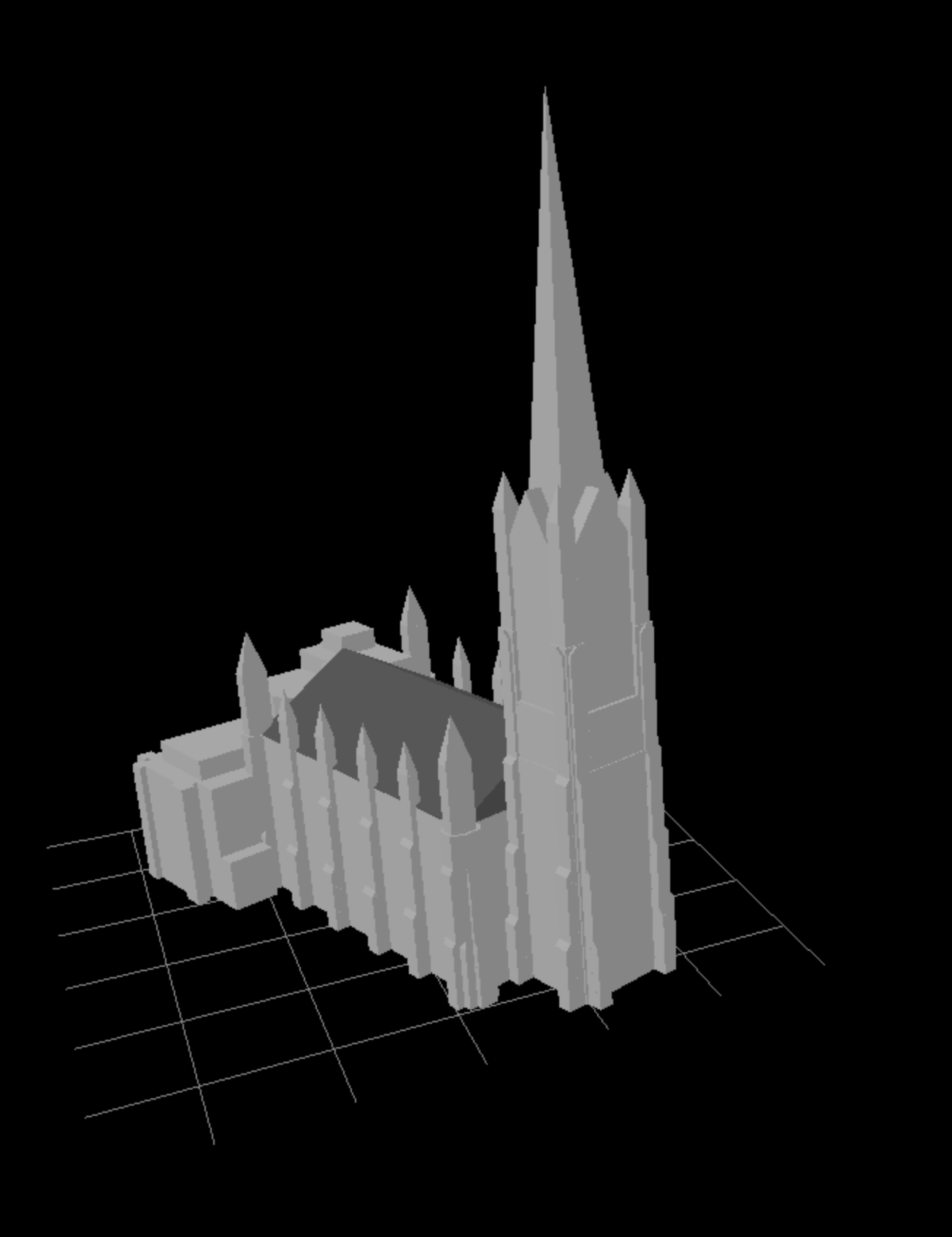
I’m working on a project using OSM building data so I thought I’d familiarise myself with the building:part and roof tags and see what the editing process is like.
The Hub only had height data and a basic outline tagged for the spire, so as the highest man made point in Edinburgh, it made for a good candidate to get stuck in.
I used height data from the OGL licensed Scottish LiDAR Phase 5 DSM that covers Edinburgh, and photos of the building from Wikimedia Commons
The elevation profile tool in QGIS proved useful for exploring the LiDAR data (after I worked out how to right-click to confirm the path). I normalised the elevation to zero with the raster calculator and set a custom colour ramp to aid visualisation:

Back “home” with Mom for the weekend, when I picked her up after church, I was advised by everyone that taking the back exit from the church parking lot. What back exit? It wasn’t on OSM or GM. (Makes sense, last time I was in that parking lot, it was all mud and construction; this exit doubles as cover for new water main or something.)
So of course I went out the normal exit, around the block and in and out of the new back entrance/exit to trace both lanes with the GPS. It is indeed now visible in our newest Mapbox imagery.
osm.org/changeset/180651021#map=17/43.834318/-70.432577&layers=VN

此文本同時提供 台灣華語版本 This article is also available in Taiwanese Mandarin
OpenStreetMap’s collaborative nature is both its biggest strength and a source of persistent data-quality issues. With thousands of contributors independently adding phone tags to shops, restaurants, clinics, and government offices, each person tends to follow their own formatting style. For Taiwan, that means a database where the same country code can show up as +886, +886+, or +886(2), and a single city’s worth of phone numbers might span a dozen different conventions.
This post catalogues what we found when we scanned OSM elements across all six special municipalities and five additional counties — we are working on a normalizer to fix the issue.
The Scale of the Problem
Across eleven cached regions — all six special municipalities (臺北市, 新北市, 桃園市, 臺中市, 臺南市, 高雄市) plus 苗栗縣, 新竹市, 臺東縣, 連江縣, 金門縣 — we found 49,260 tags (phone or contact:phone) on 49,229 elements. After splitting multi-value fields on semicolons, that yields 50,643 individual phone number strings to classify.
| Format class | Count | Share |
|---|---|---|
E.123 space (+886 2 1234 5678) |
41,842 | 82.6% |
RFC 3966 dash (+886-2-1234-5678) |
6,655 | 13.1% |
No separator (+886212345678) |
1,158 | 2.3% |
Local format, no country code (02-1234-5678) |
854 | 1.7% |
Corrupt/typo country code (+866 …, +886(2)…) |
92 | 0.2% |
| Other (wrong country, junk) | 42 | 0.1% |
Roughly 1 in 5 individual values deviates from the most common contributor convention, creating inconsistency that complicates deduplication, display, and machine parsing.
Posted by Raquel Dezidério Souto on 29 March 2026 in English.
Last updated on 30 March 2026.

The Virtual Institute for Sustainable Development - IVIDES.org® , a virtual research institute on the SD matter, and the IVIDES DATA®, a small Brazilian company on information technology consultancy, are lauching a new partnership with the State University of Campinas (UNICAMP) in order to use OpenStreetMap on the collaborative mapping of disaster risk for coastal communities on the northern coast of the state of São Paulo (Brazil).
The Virtual Institute for Sustainable Development - IVIDES.org® and the IVIDES DATA company®, in a partnership with the State University of Campinas - UNICAMP), is starting an effort to provide technical supervision and training for collaborative mapping with OpenStreetMap involving three localities (one of them in indigenous lands) along the Northern Coast of São Paulo (Brazil). These communities are still suffering with the consequences of the latest big disaster, occurred on 2023, and constitute areas with common environmental problems, like inapropriate solid waste, rivers’ pollution and deforestation.
The research focus on the micromapping with OpenStreetMap and uMap in order to develop the “Participatory Environmental Mapping” approach[1] using the collaborative approach.
We hope this project can show better the usability of open data and open software on the disaster risk reduction research, with community participation and improving the personal skills of the collaborators. It is very important, specially on areas with low income levels and literacy. This citizen science approach can opportunize the community participation.

%{count} contribution(s) in the last year
section on the user page, should be edited. For numbers greater than four digits, periods are placed in groups of three for easier reading, but OSM user profiles have numbers that are difficult to read, such as 1234565885. If we write this as 1.234.565.885 or 1,234,565,885. The contribution counter will be easier to read.


Yesterday, I attended the OpenStreetMap Local Chapters and Communities Congress 2026 online.
There were at least 15 participants who signed the attendance list on the event’s HackMD document, representing a range of countries including the Philippines, Italy, the United States, Canada, Greece, Indonesia, Belgium, Kenya, and Brazil. The document is available publicly here.
After introductions and updates from the OpenStreetMap Foundation Board, the session moved into a group discussion titled “Challenges in OpenStreetMap and overcoming those challenges.” This discussion was conducted through Mentimeter, allowing participants to submit anonymous responses to guided questions.
Here is a (selected) summary of the discussion results:
Question 1 : If a new mapper asked you “what’s the hardest part about being in the OSM community?” what would you say.
“So many smart people. All with their strong opinions about how things should be done.”
“Dealing with abusive community members.”

This text was written by me a couple weeks ago. In the mean time I noticed that my computer struggles with the amount of data to process. That’s why I will need to use another way how to create my map. Anyway, I did not want to scrap this diary entry. I learned already a lot of things and maybe you are curious about my map, so here it is:
 Like this or similar could the map look like. This mock-up was made with the QGIS GUI and OSM data downloaded over the overpass api. bigger resolution here
In this diary post, I want to show you what I am currently working on in my free time, what my motivations and inspirations were for starting the project, and what problems I have encountered. I also want to share what I have learned and what I plan to do with the project in the future.
Yesterday or the day before, Florian contacted me to see could we map hogbacks on OpenStreetMap. Short answer: Yes.
Long answer: Florian and I have spoken at two Digital Humanities conferences about citizen science and mapping and Wikidata and all that craic before, and one of our co-panellists Meagan’s doctoral thesis was about hogbacks. These are very large stones carved into the shape of very likely buildings (longhouses mostly) and date to the 10th to 12th century. They are pretty cool, to be honest. They are called hogbacks, because they also resemble the curved back of a pig, especially, when the carving is very worn and cannot be made out, which is maybe why they called them that back in the 19th century. The Vikings presumably had a far cooler name for them, but they didn’t write that down for us. Those stones were used as grave markers. (I don’t watch any of the Viking Netflix and other series, but maybe they made an appearance? Let me know in the comments - as if this was YouTube.)
Hogbacks survive or are known to have survived (who knows what might still lie undiscovered underground) in Northengland and to a lesser extent and with stylistic differences in Scotland, Cornwall (where they are called “coped stone”). One example each is known in Ireland and Wales.
Following the pattern of ogham stones for which I did go through the proposal process, Florian and I decided that we would go for the tag historic=hogback with the additional subclassification of hogback=coped_stone for the Cornish examples. I made the “executive decision” that we would be the only people mapping them anyway and that the number is so small that a proposal process would be a waste of time. I’m prepared to be judged for that.

I’ve recently learnt how to use the “Building” plugin on JOSM and it’s so slay.

Hello! I made my 1000th edit today which also just so happened to roughly coincide with the 1 year mark of my OSM journey. I have had so much fun learning about OSM and connecting with so many cool members of the community.
I started my work on OSM improving the data in my home town of Wilson Wyoming, which continues to be my main focus, although I have done some smaller projects outside of this area. It has been so rewarding to watch my work come together to create such a carefully detailed representation of its unique and beautiful geography. Through all this work I have not only deepened my passion for geographic data, I have had the pleasure of developing the understanding necessary to truly comprehend the marvel of the world’s greatest map, the open street map. I couldn’t be happier to be a part of such a remarkable feat of humanity and commendation to our planet.

HOT Mentorship Program 2025: Mapping Fire Incident Hotspots in Nairobi, Kenya.
In the last quarter of 2025, I was privileged to be part of the HOT Mentorship Program. I was a mentee in the third cohort, focusing on Open Community Building. I got to experience first-hand what it takes to work on an individual research project here in Kenya. My project was voluntary, but I learned a new meaning of that word through the project. According to the Oxford Learners’ Dictionary, voluntary is an adjective that refers to “actions done willingly, of one’s own accord, or by free choice, rather than being forced, paid, or compelled by law”. I understood that part very well, but I had little knowledge that free will doesn’t necessarily mean zero budget. So there was that.
What does it take to carry out a research project in Kenya?
While there is no “one size fits all” blanket that defines the needs for all projects, here are a few key points to consider before starting any project:
- General purpose of the project: academic thesis, community building, etc.
- Data: required datasets, available data sources, required licenses and terms of use.
- Scope of the project: geographical extent, objectives of the research project,
- Resource allocation: time, human resources/ stakeholder engagement, financial resources or physical resources.
- Legal Requirements: Associated licenses that may be required depending on the nature of the project.
Mapping Fire Incidents in Mukuru Kwa Njenga
This post presents the results of a student project carried out by the following group: Pierrick Causeret, Humbert de Chastellux, Paul Enjalbert and Othman Ouhaddou.
Introduction
This project is a follow-up of last year’s project Shade-optimized routing paths for pedestrians which introduced a shade routing calculator for OSM. Our objective was to make this project available on mobile.
Choosing an App
We first had to choose an app or website to work on. We wanted something easy to publish for us and easy to install for potential users. It also needed to work on both Android and iOS. This excluded all apps that didn’t have plugins or ways to customize them without editing the core code. With all those constraints, we settled on OsmAnd.
Creating the shade data
The full pipeline integrates the previous project, which is the calculation of the shade percentage for each way. This information is then added in the .pbf file as a tag, and then converted to .obf for the app.

I’m new to this.
I did what most people probably do and added/adjusted footprints of houses in my neighborhood. Great but I soon noticed that there were choices to be made about what did or didn’t get included, what level of detail to go to, etc. and no really obvious source of guidance about that.
Which is probably just as well, because if there were masses of prescriptive guidance about every little thing a new user would get buried. Anyway. I settled on what seemed reasonable to me and fleshed out the neighborhood a bit. Fun.
I’m a private pilot, so I checked out my local airport to see how things looked there. It was really quite good in some respects, if a little out of date. But again since there’s no guidance the previous editors had just made reasonable assumptions and got on with it. I noticed a few taxiway connections were missing (I taxi along them regularly so I know they’re there!) and added them. Then realized that the previous editor had only been adding taxiways that correspond to the painted lines. Reasonable but in reality things are more joined up than that. Food for thought.
So I thought I would check out a large nearby airport. Whoever did this has made a different set of assumptions about what a reasonable level of detail is. Nothing wrong with them, just different.
Then I checked out Chicago O’Hare. Wow. Someone went to town here. Every single parking spot in the parking garage is individually mapped. That seems excessive (and dragged my machine to it’s knees as well). I’m sure some aggregation would be better. Never mind.
Checked out Newark. Much more reasonable level of detail here. But I suppose that depends on what you expect people to use it for. JFK is different again.
Posted by ThisGuyJustLikesToMakeMaps on 17 March 2026 in English.


For some reason, the sidewalks near main roads in Sandy have been deleted without much warning. I just have to question what is with these changes and who is responsible for removing the work of mine and others.
Hello,
I recently noticed that Someone, Which I do not know of, Has vandalised clyst vale by Removing the entire school, and replacing it with a sainsburys, ive wrote this to alert a mod to hopefully revert the changes at clyst vale
-SouthWestTrains1